

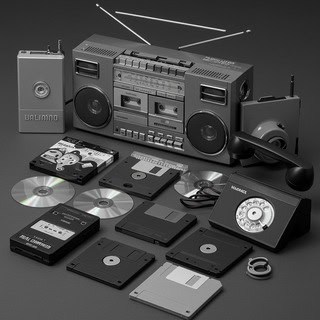
It’s hard to imagine that there was a time when you could walk out of your home and see people going about their days without having their noses stuck in a phone. And yet, this was a reality just a few decades back.
People actually had to talk to each other (shocker, we know), and write handwritten letters to stay in touch with their loved ones across the country.
It wasn’t until the 1980s that new personal tech inventions began popping up. In fact, most of the ‘80s tech laid the groundwork for our modern devices! Here’s a deep dive into the 1980s technology that shaped the decade (and future ones!)
Key Takeaways
| – The Birth of “Personal” Tech: The 1980s marked the first decade where high-end technology moved from laboratories and corporations into the average American home. This “Consumer Revolution” turned computers, camcorders, and mobile phones into household items. – The “Brick” Origins: In 1983, the Motorola DynaTAC 8000X became the first commercial mobile phone. Despite weighing 2.5 pounds and costing nearly $4,000, it laid the 1G analog foundation for the ultra-slim, AI-integrated smartphones of 2026. – GUI & Modern Computing: Before 1984, computers required complex text commands. The introduction of the Graphical User Interface (GUI) by Apple made computing intuitive, leading directly to the touch-and-swipe interfaces we use today. – The High-Fidelity Shift: The 1982 launch of the Compact Disc (CD) by Sony and Philips was the first major step toward digital audio. While physical CDs are now nostalgic artifacts, they pioneered the high-quality, skip-free audio standards that evolved into today’s lossless streaming services. – Handheld Memories: Sony’s 1983 Betamovie and the JVC GR-C1 made at-home video recording possible. These bulky, shoulder-mounted units are the direct ancestors of 2026’s 8K smartphone cameras and social media content creation. |
Forgotten 1980s Technology
At a glance, here is some of the most popular tech from the ‘80s that has slowly vanished into the ether:
- Walkmans
- Compact discs (CDs)
- Boomboxes
- Pagers
- Answering machines
- VHS tapes
- Floppy discs
- Rotary phones
- Calculator watches
Designed by Freepik
On the flipside…
What Tech From the 1980s is Still Used Today?
A lot of technology that went mainstream in the 1980s still gets used in our daily lives today:
- Personal computers
- Graphic User Interface (GUI)
- Camcorders
- Vinyl records
- Mobile phones
- Video game consoles
- Disposable contact lenses
Keep in mind, even though these products and tech were in use in the 80s, they were vastly different from their modern counterparts! Let’s discuss the 1980s tech in more detail.
13 New 1980s Technological Innovations
Whether you lived through the ‘80s and personally used some of these tech inventions, or simply heard about them from your older relatives, here are the most notable tech innovations of the ‘80s that changed the entire landscape. And while you’re at it, try to recall a fond memory associated with each piece of tech.
Maybe you listened to Thriller for the first time on the bus ride to school. Or maybe the very first computer you had ran on a primitive Windows OS! Reminisce
1. Personal Camcorder (& At Home Videos)
Remember the boxes and boxes of VHS tapes your parents had, filled with home-recorded videos of your childhood? They were grainy and had that sepia-toned, old-timey feel, but, boy do they bring back memories.
This was all thanks to the handheld camcorders that were invented in the 1980s. The first ever consumer camcorder, the Betamovie BMC-100P, was introduced by Sony in 1983. It used a Betamax cassette and had to be mounted on your shoulder.
That same year, JVC invented the more compact VHS-C tape format, which was designed for more portable equipment and could be played back by popping into a VCR. In 1984, JVC designed its GR-C1 camcorder that used VHS-C tapes and was more convenient for users. Remember Doc Brown from Back to the Future? He uses a GR-C1!

Ignat Gorazd, CC BY-SA 2.0 <https://creativecommons.org/licenses/by-sa/2.0>, via Wikimedia Commons
2. Compact Discs (CDs)
Up until the early 1980s, vinyl records and cassette tapes were how you could listen to music. Then, in 1982, Phillips and Sony together finalized the format for CDs, which ushered in an era of portable music and love confessions by way of mixtapes.

Toshi sanyoshi, CC BY-SA 4.0 <https://creativecommons.org/licenses/by-sa/4.0>, via Wikimedia Commons
These thin, circular discs made it easy for everyone to enjoy a higher quality of audio along with the ability to skip songs. You could burn your own playlists onto the CDs and enjoy up to 80 minutes of music. These compact discs also lasted longer than vinyl records or cassettes.
3. IBM Personal Computer
Technically, personal computers existed even in the ‘70s. But, it was IBM’s personal computer, “Acorn,” that became the industry standard.
The Model 5150 PC was introduced in 1981, instantly becoming popular because it was made by trustworthy IBM. The Acorn had an Intel 8088 microprocessor and the MS-DOS operating system. It was also faster than all the previous PCs and sported 10x their memory capacities. While the speed and OS would seem shockingly bad to a modern person, it was extremely impressive at the time!

Federigo Federighi, CC BY-SA 4.0 <https://creativecommons.org/licenses/by-sa/4.0>, via Wikimedia Commons
Companies that had previously been skeptical of PCs now began buying the Acorn in bulk. It was the IBM PC that culminated in the modern computers and laptops we use today.
4. Mobile Phone
It was in 1983 that Motorola unveiled the very first handheld mobile phone to the public: the DynaTAC 8000X. It was invented by an engineer called Martin Cooper a decade prior.
At 1.1kg (2.5 pounds) with a long antenna, the DynaTAC was, quite literally, a brick. But, it allowed people to carry it with them and make phone calls from wherever they chose, without being limited by a landline.

Redrum0486, CC BY-SA 3.0 <https://creativecommons.org/licenses/by-sa/3.0>, via Wikimedia Commons
This phone cost nearly $4,000, had to be charged for 10 hours, and only allowed half an hour of talktime. If you’ve ever watched Wall Street, you might remember the phone as being used by Gordon Gecko!
5. Modern Disposable Camera
In 1986, Fujifilm launched the first ever modern disposable camera known as the QuickSnap. Priced at $10, this single-use, point-and-shoot camera made photography accessible to everybody, including kids.

Jud McCranie, CC BY-SA 4.0 <https://creativecommons.org/licenses/by-sa/4.0>, via Wikimedia Commons
Not one to be left behind, Kodak followed with its own disposable camera, “Fling,” which cost less than $7.
All you had to do was point and click the button. Once all of your film rolls were used up, you dropped off the camera at the shop you bought it from, and the company would develop your photos and send them back to you.
You might remember photos of your parents (or yourself!) captured using one of these cameras!
6. The Walkman
Remember the Walkman? It was to ‘80s kids what the iPod was to 2000s kids. Pop the earphone buds in, crank up your favorite music, and you were pretty much lost to the world. It was a tech that made music portable and private. It was cool and kept prying ears away.
Technically, the very first Sony Walkman was sold in Japan in 1979, but the ‘80s were the decade of the Walkman in the U.S. and globally, so it would be remiss not to include this piece of tech here.

ocean yamaha, CC BY 2.0 <https://creativecommons.org/licenses/by/2.0>, via Wikimedia Commons
It was the Walkman that popularized CDs, and the ‘Walkman’ name became a universal shorthand for any portable music device, regardless of the manufacturer.
7. TV Watch
TV in a watch? Yep! Seiko released the world’s first TV watch in 1982, which allowed users to catch up on their favorite TV series wherever they were. It had a small 1.2 inch screen that displayed the time at the top. The rest of the screen was for the TV. You also had to carry a separate TV receiver, but it was a small price to pay for having a portable TV on your wrist!
The TV watch was surprisingly advanced. It had a tuner, headphones, FM radio, alarm, and even a calendar. Most surprisingly, though, it was made with LCD and had a battery that lasted a good 5 hours.
The Guinness Book of World Records called it the “World’s Smallest Television.”
8. Graphical User Interface (GUI)
Before the invention of GUI (i.e. the intuitive interface with icons that makes devices super easy to use), you had to type text commands into your computer. But, this all changed when the Xerox Palo Alto Research Group came up with the very first GUI prototype in 1979.
The first ever personal computer with a GUI, though, was Apple’s Lisa, developed by Steve Jobs. It was this piece of technology that made GUI available to the public.
Though practically nobody bought Lisa, Apple released the original Macintosh shortly after (yes, the Mac that predates all Macs) in 1984. It had MacPaint and made word processing super easy! Needless to say, it was a huge success, and was what inspired Microsoft Windows.

Sagie, CC BY-SA 2.0 <https://creativecommons.org/licenses/by-sa/2.0>, via Wikimedia Commons
9. Microsoft Windows
You probably have (now, or in the past) used the Windows OS on your computer. But, did you know that it was first created in 1985? It was created to compete with Apple’s GUI-based computers.
Windows 1.0 was the first GUI in 16-bit, and needed the use of a mouse to be fully functional. It duplicated a lot of Apple’s GUI elements. Oh, how far we have come since then!
Fun fact: When Windows 1.0 came around, the mouse was not a commonly used device. So, the OS included a game called Reversi to help people get acclimated with using the mouse.
10. Disposable Contact Lenses
Disposable contact lenses that were designed to be worn only once were actually introduced in 1987. You had to wear a fresh pair of lenses every single day.
They became a more convenient and more hygienic way of wearing lenses. People no longer had to diligently clean and store their contact lenses, or worry about losing them. These “dailies” also made it easier for athletes, etc. to wear contact lenses sporadically as needed.
11. 3.5 Inch Floppy Disks
The very first floppy disks, invented in the 1970s, were huge, with a diameter of 8 inches. But, in the next decade, these storage devices became smaller, until the 3.5 inch compact diskette was invented in 1982.

Dsimic, CC BY-SA 3.0 <https://creativecommons.org/licenses/by-sa/3.0>, via Wikimedia Commons
These micro diskettes came in both single-sided and double-sided varieties. In fact, the very first Mac used a single-sided floppy disk!
12. 3D Printing
While 3D printing (aka stereolithography) may just have started becoming mainstream, it was actually invented in 1983 by Charles “Chuck” Hull. He used his own technology to 3D print plastic prototypes for the business he worked at, speeding the process.
Hull’s 3D printer created objects by placing layers of a photopolymer resin that was hardened and bonded by UV light on top of each other. It’s said that the very first 3D-printed object was a simple eye wash cup.
When manufacturers saw the benefits of his technology, they began using it to manufacture parts faster. 3D printing found a great deal of use by manufacturers of car parts, medical equipment, and aerospace.
13. Nintendo Entertainment System (NES)
While the credit for bringing video game consoles into people’s homes goes to the Atari 2600 (released in the ‘70s), it was the Nintendo Entertainment System that truly revolutionized the video gaming industry, setting new development standards.

Matthew Paul Argall from Australia, CC BY 2.0 <https://creativecommons.org/licenses/by/2.0>, via Wikimedia Commons
First released in 1983 as the Famicom in Japan, the NES was better than the Atari 2600 in every way. It was an 8-bit console that allowed users to play arcade games such as Donkey Kong from the comfort of their home. It also offered better graphics and sound, and could play more complex games. You might recall battling it out with your friends with the classic Super Mario Bros and The Legend of Zelda games.
After the NES became a smashing success, Nintendo released its first Game Boy in 1989 in Japan before releasing in North America and globally in 1990. This device went on to become one of the most popular handheld gaming devices in the ‘90s.
How ‘80s Tech Still Influences Us Today
The technologies that existed before the ‘80s were primitive and very basic compared to today’s standard. But, it’s all these 1980s technology innovations that laid the groundwork for the sleek, super-fast, modern devices we use today.
The most notable devices we use today that were pioneered in the ‘80s are laptops, digital watches, mobile phones, digital photography and videography, 3D printing, and video gaming.
It was also this decade that made consumer tech mainstream. A lot of technology, such as mobile phones, cameras, and computers reached people’s homes during this era.
If you miss any of these tech products from the ‘80s, you can still find some vintage pieces being sold online!
Take Your Nostalgia to the Next Level With Classmates®
If going on a stroll down the tech memory lane triggered some fond memories from the ‘80s, why not go through old yearbooks or connect with your high school friends to see what other memories you can dredge up?
Classmates has an extensive collection of yearbooks from the ‘80s for you to browse, potentially including your own. Register for free, search for your friends, and even look at yearbook pictures featuring technologies used in the classroom back then.
Related Nostalgia Blogs:
- What Were High Schoolers Like in the 1980s
- Cool Vintage Yearbooks From the ‘80s and Other Decades
- Best ‘80s Fashion Styles
- Hairstyle Trends From the ‘80s
- Best TV Shows of the ‘80s
- Rad Expressions From the ‘80s
- How The Belleville Three Influenced ’80s Music
- Ideal Decade Party Planning
All product names, logos, brands, trademarks, and copyrights are property of their respective owners.


