

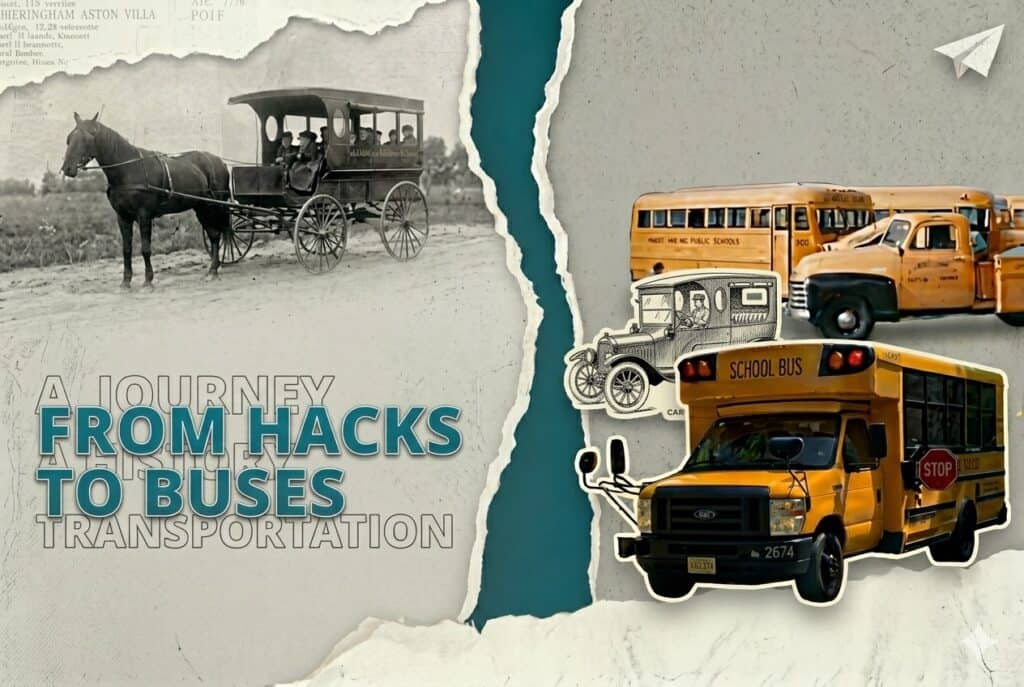
The yellow school bus has the unique ability to transport us right back to our childhood. The crunch of the gravel on the road, trying to share a seat with your crush, and spending the whole ride playing games with your friends: these are memories that have been etched in our minds.
And if you had a nice bus driver who always greeted you by name and waited for you even if you were 2 minutes late? It just made you feel extra special.
From taking you back-and-forth to school, to helping you create memories that will last a lifetime, the yellow school bus is an American cultural icon. But, did you know that the first school bus goes way back to the 1800s? Here’s a deep dive into the history of school buses.
Key Takeaways
| – When were school buses invented? School buses date back to the 1800s, beginning as horse-drawn “kid hacks” or “school wagons” repurposed from farm equipment. By 1919, all 48 U.S. states had received funding for school bus transportation, making them a nationwide staple. – Why did school buses become a necessity? As compulsory education laws spread across the U.S. in the mid-1800s, schools needed a reliable way to transport children. School buses solved this problem and have been essential ever since. – How have school buses evolved over time? From open-sided horse-drawn wagons to all-steel motorized vehicles, school buses have undergone significant safety and structural improvements over the decades, including the adoption of the iconic yellow color in 1939, chosen for its superior visibility. |
When Were School Buses First Invented?
American school buses have been around since the 1800s. In those days, kids in rural America had to travel long distances (typically on foot) to get to school. The lack of transportation meant that kids often skipped school.
To prevent this, schools came up with a transportation idea: horse-drawn carriages known as “kid hacks” or “school wagons.” They were, essentially, repurposed farm wagons that left the kids exposed to the elements. This was the earliest version of the modern school bus we see today.
While the kid hacks were certainly a start, they still weren’t enough. In 1892, a school district in Ohio commissioned Wayne Corporation, an Indiana-based automotive company, to design a wagon whose sole purpose would be transporting kids to school.
The company came through, designing a horse-drawn wagon with perimeter seating (where the kids had to face each other instead of the front) and a single entrance at the back (so as not to spook the horses). These wagons had a roof, but the sides were left open. They lovingly dubbed it the “School Car.”
Fun fact: The rear emergency exits we see in school buses today were inspired by the single back entrances that the earliest “School Cars” had.
When Did School Buses Become Commonplace in America?
School buses became commonplace in America by 1919. Let’s rewind a little to what happened after the first “School Car” was built.
By 1900, a total of 16 states were using school buses to transport kids to and from school. It was around this time, in the beginning of the 20th century, that motorized vehicles started gaining prominence, which brought on the next iteration of the school bus.
The modified versions had the same wooden benches, perimeter-type seating, and a rear entrance, except they were motorized and had a tarpaulin spread over the seats as a way of weather protection.
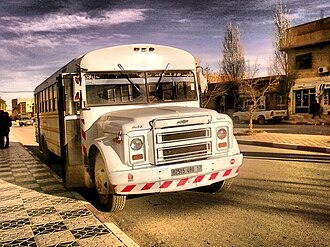
In 1914, Wayne Corporation began making motorized school cars that borrowed elements from both a trolley car and a Model T, and came with four padded seats. By 1915, International Harvester (now Navistar) had also entered the motorized bus production business.
By the time 1919 rolled around, all 48 U.S. states had received funding for the usage of school buses, making them commonplace across the country.
Musclesfan, CC BY-SA 3.0 https://creativecommons.org/licenses/by-sa/3.0, via Wikimedia Commons
Why Were School Buses Seen as a Necessity in the U.S.?
In the 19th century, when most of America was covered in farmlands, educational institutions mostly consisted of one-room schoolhouses often located miles away. It was unrealistic for any child to make the trek to and from school every day. This, coupled with the seasonal nature of farm work that needed all hands on deck during harvest season, meant that many kids weren’t regulars at school.
But, in the mid-1800s, Massachusetts passed a law making education compulsory, with other states soon following. This meant schools needed to come up with a way for children to get there. The solution came in the form of school buses, which gave kids the opportunity to access education.
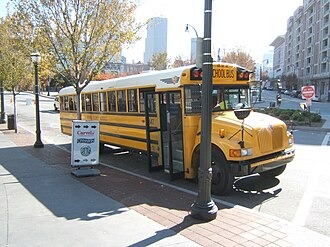
As the decades passed, and the one-room schoolhouses consolidated into bigger schools, school buses became even more of a necessity. Today, in addition to making sure kids get to school, school buses also provide safety during transportation.
Rundvald, Public domain, via Wikimedia Commons
How Have School Buses Evolved Over the Years?
1920s Buses
After school buses became more common in 1919, their popularity only rose. Manufacturers began thinking more about safety, introducing closed compartments and seat-backs that were made of metal in the 1920s.
Most notably, in the second half of the 1920s, A.L. Luce, a Ford dealership owner, attached steel panels and frames beneath the wooden bodies of school buses to make them more sturdy. To protect the kids from the elements, canvas roll-ups were added to the windows. This was the very first Blue Bird bus, made by a company which is still in operation today!
1930s School Buses
Just a decade later, more advanced safety features were introduced. It’s around this time that school districts began owning the school buses. The first all-steel buses were manufactured, with Wayne Works adding glass windows to their productions for added safety. This is also when the entrance moved to the front, turning the rear entrance into an emergency exit.
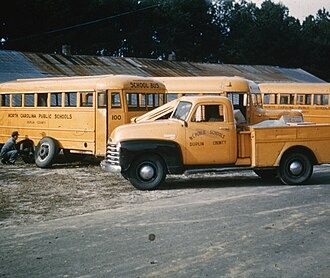
Despite these changes, there were no nationalized standards for bus safety, which changed at the 1939 conference, organized by an American educator, to establish school bus safety standards. It was here that yellow (specifically, “National School Bus Glossy Yellow”) was decided as the uniform school bus color.
The reason for this is that yellow is the most visible color, and is registered by our peripheral vision faster than any other color. This would provide added safety to the vehicles as other drivers would be able to spot them quite easily. Within the next few decades, each school bus came to be painted yellow.
Buses in the 1950s to Today
After World War I, the demand for school buses increased, these kid-toting vehicles began evolving, too. The school bus capacity increased, warning lamps were added to indicate that the bus was getting ready to drop students off, and diesel engines were introduced. Wheelchair lifts were also introduced to enhance accessibility.
State Archives of North Carolina, No restrictions, via Wikimedia Commons
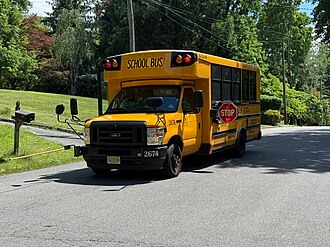
Famartin, CC BY-SA 4.0 https://creativecommons.org/licenses/by-sa/4.0, via Wikimedia Commons
Over the next few decades, more changes were made to school buses, including the addition of:
- Stop sign arms
- Taller seat backs
- Cross-view mirrors
- GPS systems
The buses also became structurally sound, giving way to the yellow school buses we all know and love.
The Future of School Buses
To decrease the carbon footprint of school buses, they are now going electric! This move is also a way to reduce the respiratory issues that kids face due to the exhaust from diesel engines.
What’s more, we might also see other advancements in school buses, such as:
- Wi-Fi connectivity on the go
- AI-powered routing
- Ability for parents to track school buses in real time
- Biometric entry and facial recognition
- Collision avoidance sensors
- Smart, dynamic routing to conserve fuel
- 360-degree cameras
Nostalgic School Bus Games
Remember the games you used to play with fellow bus-goers on the way to school? Maybe it was a way for you to make new friends, or maybe you simply used them as an excuse to talk to your crush.
Either way, playing games on the school bus made the commute so much better, giving us memories to last a lifetime. Here are a few of the most popular games you’re sure to feel nostalgia for:
- I Spy: A kid picks an object they see out the window and gives a clue so that the others can guess what it is. For example, “I spy with my little eye a blue object.”
- License plate games: Everyone tries to find license plates from different states. The one who collects the most states wins!
- 20 questions: A kid thinks of a person, place, or thing. The rest of them have to guess what it is by asking 20 yes-or-no questions.
- Two truths and a lie: Each kid goes around telling two truths and a lie about them. The others have to guess which one is the lie. It was a great game to get to know your peers.
- Would you rather? Each kid poses a “would you rather?” question with two scenarios to get to know what their peers would choose. For example: “Would you rather get $1 million now, or get $1,000 weekly?”
Relive Your High School Experiences with Classmates®
If reading about the history of school buses took you back to your high school days, you’re not alone. Standing on the sidewalk, waiting for that yellow bus to arrive and bring all your friends with it, especially on the first day of school after winter break… that’s something no adult experience can compare to.
But, you can reminisce about it with your high school pals. With over 480,000 yearbooks archived, and the ability to search for old friends, the Classmates website helps you relive your high school school days.
Register for free and get started!
Related High School Blogs
- High School Typing Classes of the Past
- Senior Yearbook Ad Ideas
- Biggest Illinois High Schools
- 1950s High School Life
- Remember Your Varsity Jacket?
- Biggest American High Schools
- The ‘90s High School Experience
- A Look at 1970s High School
- High School in the ‘80s: A Deep Dive
- Best Coming of Age Movies
- Largest High Schools in Texas
- Uncovering Your Old Class Pictures
- High School Celebrity Pairings
- 75 Biggest CA High Schools
All product names, logos, brands, trademarks and copyrights are property of their respective owners.


